
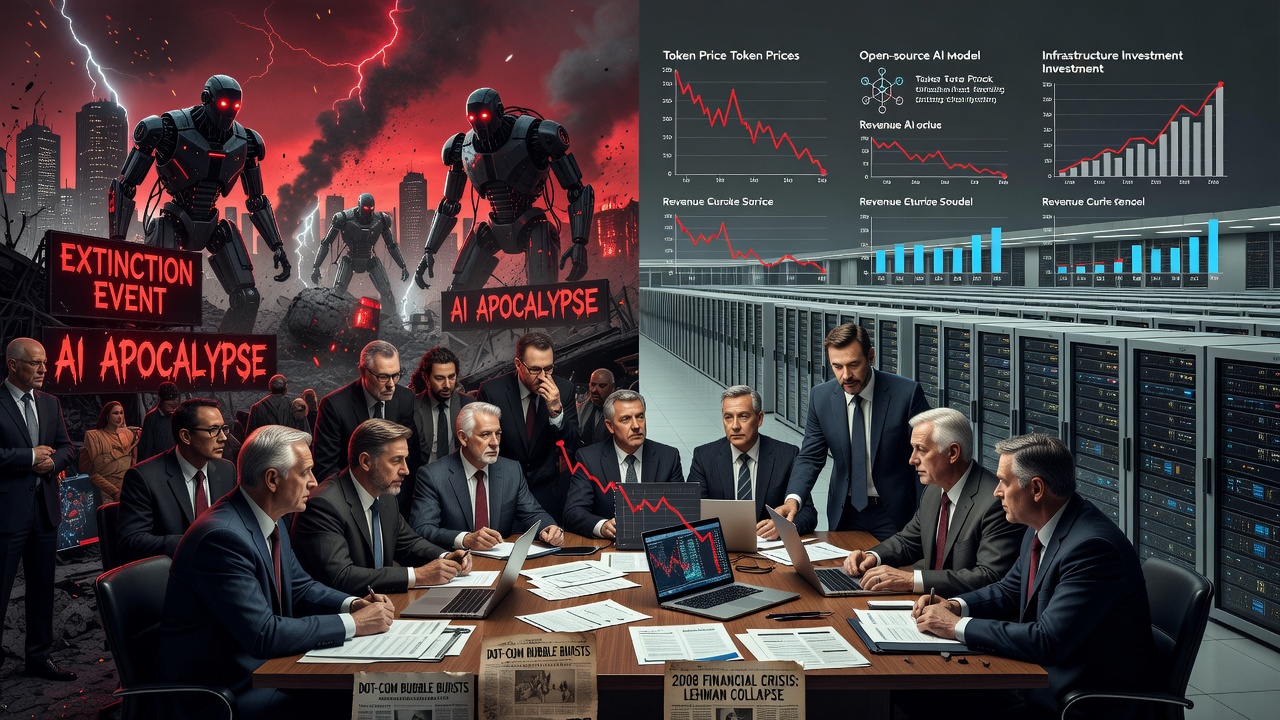
The loudest voices in artificial intelligence keep framing the technology as an existential threat to the species, while the harder, more immediate question gets less airtime: whether the companies building these systems can justify what they are spending. That question is not about extinction. It is about business fundamentals, and it belongs squarely in the realm of market risk rather than science fiction.
Who Actually Poses the Risk
There is a meaningful distinction between fearing a technology and fearing the people who control it. A model does not develop intent on its own. The decisions about how it gets deployed, who gets access, and what guardrails exist around it are made by executives, investors, and engineers. That is the more grounded version of the AI-safety argument, and it shifts the conversation away from speculative catastrophe and toward something regulators and markets already know how to evaluate: governance, incentives, and accountability inside a handful of powerful companies.
The Spending-Versus-Revenue Gap
Every technology bubble in recent memory looked obvious only after it collapsed. The dot-com crash, the 2008 financial crisis - in hindsight, the warning signs were sitting in plain view. The current AI buildout carries its own version of that warning sign: enormous capital expenditure on infrastructure and compute, set against revenue that has not yet caught up. Industry analysts have raised this gap repeatedly in recent reports, pointing out that the money being poured into model training and data centers assumes future demand that has not been proven at scale.
That gap matters because it determines whether the current wave of AI investment behaves like a durable industry or like a speculative cycle. Token prices, the cost charged for processing AI requests, have been falling as competition increases. At the same time, open-source models are gaining adoption, even if they remain a modest share of the overall market. Both trends squeeze the pricing power of the largest frontier-model developers, the same companies that need enormous and sustained revenue to justify their infrastructure bets.
Where the Uncertainty Really Sits
Nobody currently has a complete picture of which applications will generate lasting commercial demand for advanced AI systems. That uncertainty is the real vulnerability, more concrete than any hypothetical about machines turning against their creators. If enterprise and consumer use cases fail to scale the way current valuations assume, the companies carrying the heaviest infrastructure costs face a reckoning that looks familiar from past technology cycles - not an apocalyptic one, but a financial one involving write-downs, consolidation, and investor losses.
- Falling token prices reduce margins for companies selling AI access as a service
- Open-source alternatives lower switching costs and threaten vendor lock-in
- Capital expenditure on compute and data centers is front-loaded, while revenue growth remains uncertain
- Demand for specific AI applications at enterprise scale has not been fully proven
A More Useful Frame for Risk
Climate-related events are measurable, recurring, and already affecting insurance markets, infrastructure planning, and household finances in ways that are documented and visible. Framing AI primarily as an extinction risk tends to crowd out scrutiny of the more mundane but consequential questions: concentration of power among a small number of companies, the sustainability of their business models, and whether public and investor attention is being pointed at the wrong problem. Treating AI as a business and governance issue, rather than a doomsday scenario, gives regulators, investors, and the public a clearer basis for asking the right questions before the next bubble becomes obvious only in hindsight.