
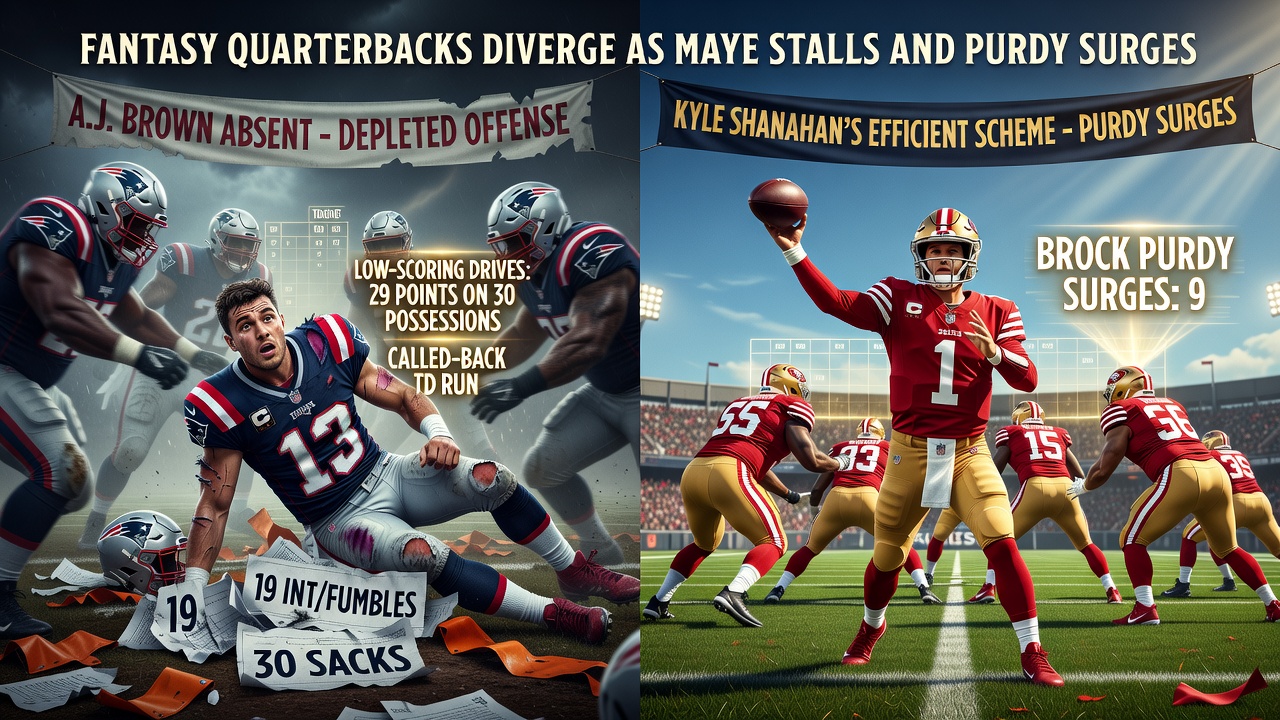
Three weeks into the fantasy football season, the gap between expectation and reality has rarely been starker at the quarterback position. Drake Maye, last year's runner-up for MVP and fantasy's QB2, has collapsed to QB35 production, while Brock Purdy, playing behind a depleted receiving corps, trails only Josh Allen in total scoring. The split says as much about offensive systems and roster context as it does about individual talent, and it carries real consequences for anyone trying to set lineups or evaluate trade value this week.
Maye's Numbers Point to a Structural Problem
A called-back 21-yard touchdown run last week briefly obscured what has otherwise been a rough stretch for New England's offense. Maye is producing his lowest adjusted net yards per attempt since 2021, and the turnover and pressure data are harder to dismiss than a single nullified play. Nineteen interceptions or fumbles and thirty sacks over his past seven games, dating back to last season's playoffs, describe a quarterback under duress rather than one in a slump. The Patriots have scored just 29 points on 30 drives this season - the fewest through three games by any team since Zach Wilson's rookie stretch, a comparison that underscores how far the offense has fallen. A shoulder injury, the absence of A.J. Brown, and a tougher schedule all offer partial explanations, but none fully account for the scale of the decline.
Purdy's Efficiency Reflects System Design
Purdy's 9.5 yards per attempt and zero sacks taken are not sustainable in isolation - regression is likely as the season lengthens. But the underlying skill set, accuracy, mobility, and fit within Kyle Shanahan's scheme, explains why he has remained productive even after losing key weapons. Purdy's situation is a reminder that quarterback value in fantasy formats often depends less on raw arm talent than on scheme protection and play design, a distinction that matters when projecting performance over a full season rather than a single hot stretch.
Skill-Position Shifts Worth Tracking
Beyond the quarterback split, several skill-position trends deserve attention. Brock Bowers returned from injury doubt to lead all tight ends in targets, signaling he may already be the focal point of Las Vegas's new passing scheme under Klint Kubiak. Jeremiyah Love has emerged as a workhorse back after a slow start, while Jaxon Smith-Njigba's target share and yards per route run have actually increased without the coordinator who oversaw his breakout. Zay Flowers is producing at an elite rate in limited snaps, though a recurring hamstring issue remains a genuine risk to his availability. Malik Nabers, by contrast, faces uncertainty tied to quarterback instability rather than health alone, with a new signal-caller and a coordinator history that has previously suppressed receiver production elsewhere.
What It Means for Lineup Decisions
None of these trends guarantee future results - football outcomes involve variance that no weekly snapshot can fully capture. Treating three-week samples as settled fact is a common mistake in fantasy management, much as it is in any form of wagering built on incomplete information. The sounder approach weighs usage, scheme, and health status together rather than chasing the most recent box score.