
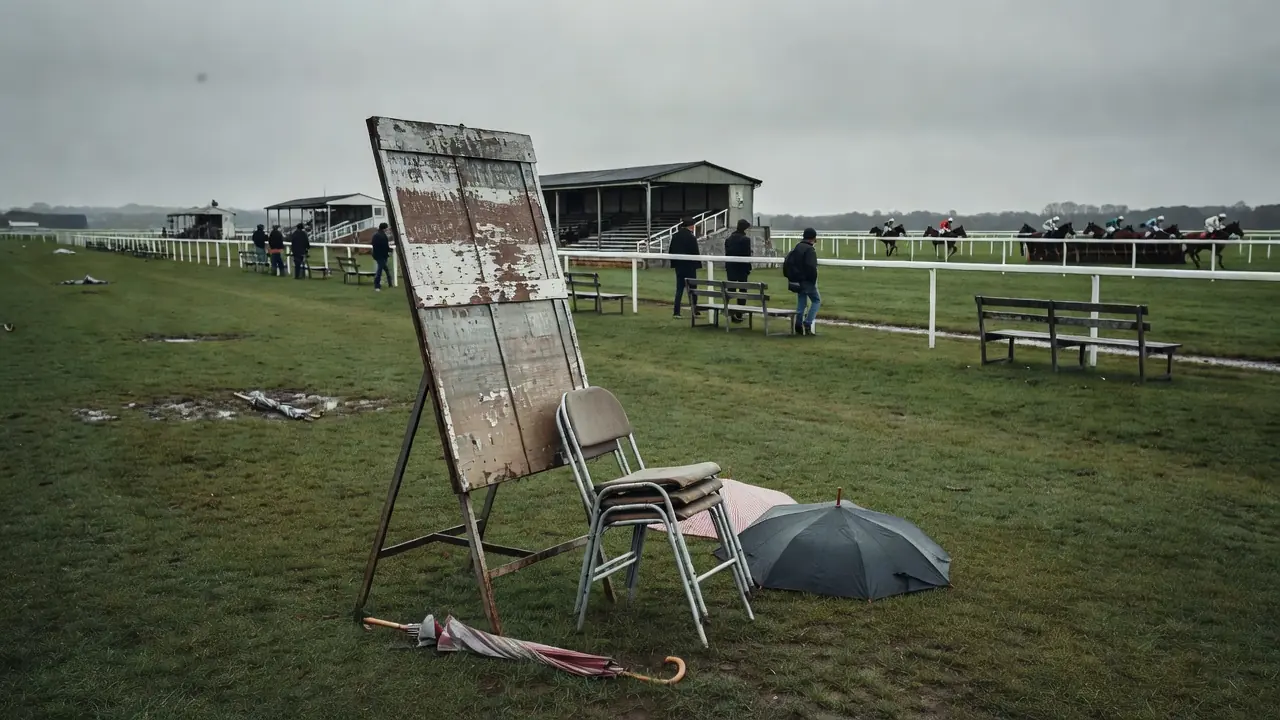
A single bookmaker standing alone on the rails at Hereford racecourse, taking a few hundred pounds across an entire card, tells a sharper story about British horseracing than any attendance figure. Behind the colour of race day reporting lies a persistent structural problem: small, midweek jump meetings increasingly struggle to generate enough betting turnover to sustain the on-course bookmaking pitches that have underpinned the sport's funding model for generations.
Why On-Course Betting Volumes Matter
On-course bookmakers operate on thin margins that depend on volume. A pitch facing the stands needs enough punters walking past, pausing, and placing stakes to cover pitch fees, staff, and travel, before any profit is made. When a neighbouring pitch is left empty because other bookmakers decided the fixture wasn't worth attending, that is a market signal. It reflects expected footfall and field money, not enthusiasm for the sport itself. A day where total field money across seven races amounts to a few hundred pounds is, in commercial terms, barely viable.
This matters beyond the betting ring. On-course bookmakers contribute to the atmosphere and functioning of a racecourse, offer price competition against digital platforms, and represent one of the few remaining visible, person-to-person betting experiences in an industry that has moved overwhelmingly online and onto exchanges. Their gradual retreat from smaller fixtures is a quiet but consistent trend across British racing.
Favourites, Fallers, and the Illusion of a Pattern
Several results on the card went against the book - a fallen favourite here, a drifting price finishing unplaced there - and in isolation each looks like misfortune for the bookmaker. Over a full card, though, these swings average out, which is precisely why bookmaking as a business depends on scale rather than any single race. A firm that loses on three races and wins on four is not experiencing luck; it is experiencing the normal variance built into pricing a market. The danger for any observer, professional or casual, is reading short-term results as evidence of a system or a trend that can be exploited. It cannot. Odds reflect probability and margin, not guaranteed outcomes.
The Rise of In-Play Markets and Changing Punter Behaviour
One detail stands out: a favourite trading at prohibitive odds on the exchange in-running market while on-course bookmakers continued pricing it conventionally. This illustrates a genuine shift in how betting liquidity now moves. Exchanges and in-play markets have pulled significant volume away from traditional ring betting, particularly among more price-sensitive or data-driven bettors who follow live markets on mobile devices rather than approaching a bookmaker's board. Smaller racecourses, with patchier mobile signal and older demographics among attendees, haven't fully absorbed this shift, which partly explains why some pitches now see such modest turnover even when crowds are reasonable.
What It Means for the Wider Betting Market
- Thin on-course turnover increases pressure on racecourses to rely on media rights and online betting revenue rather than ring fees.
- Bookmakers facing unsustainable midweek fixtures may reduce pitch numbers further, concentrating trade at major meetings.
- Exchange and in-play betting continue to draw liquidity away from traditional fixed-odds ring betting, reshaping how prices are formed.
- Consumers should treat any single day's results, favourable or unfavourable to the book, as normal variance rather than a signal that betting outcomes can be predicted or systematically beaten.
None of this suggests racing's smaller fixtures are disappearing, but it does point to a sport whose betting infrastructure is adapting unevenly. Major festival days remain commercially robust; quieter midweek cards increasingly depend on hope rather than forecastable demand. For anyone engaging with betting markets, the lesson is less about tips and more about realism: pricing reflects risk, not certainty, and no amount of pattern-spotting from a quiet day at Hereford changes that basic arithmetic.