
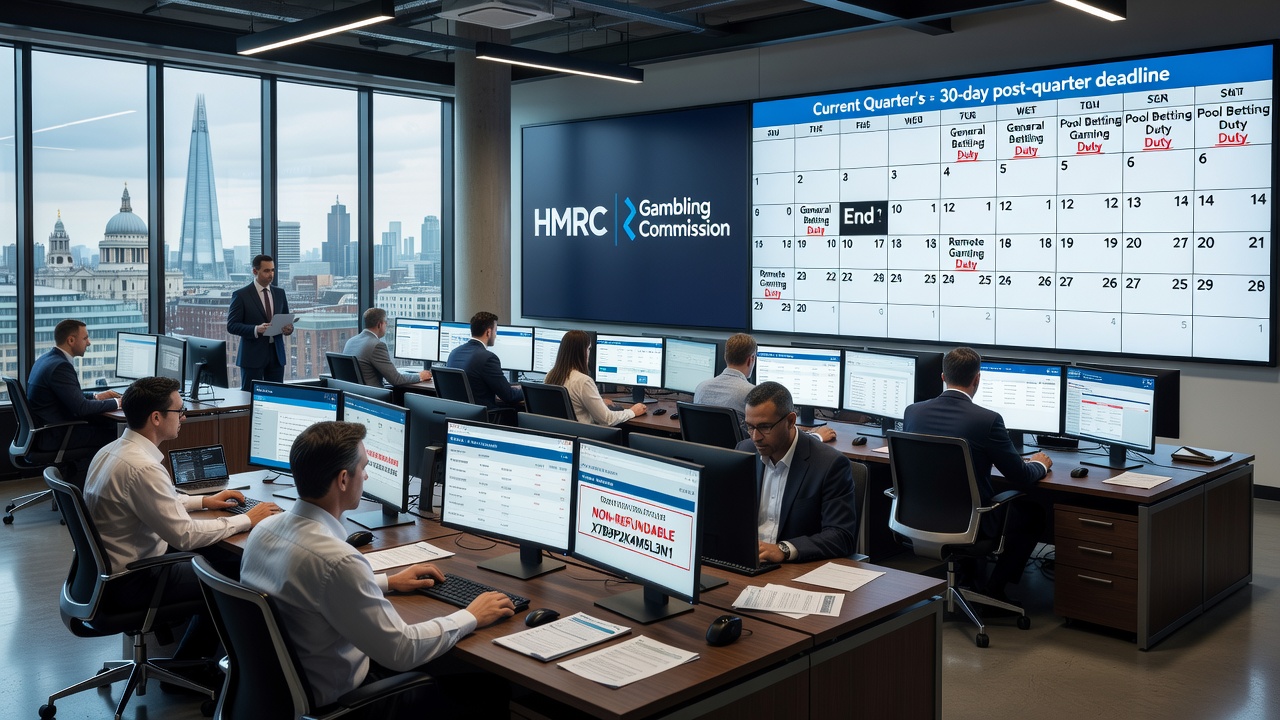
Operators running betting or remote gaming businesses in the UK must reckon with a recurring administrative obligation that carries real financial consequences if mishandled: the payment of General Betting Duty, Pool Betting Duty or Remote Gaming Duty. These duties apply four times a year, and missing a deadline can trigger penalties and interest charges on top of the duty itself. For an industry already under close regulatory watch, getting this process right is not optional paperwork - it is a core compliance function.
Why the accounting cycle matters
Each duty operates on a quarterly accounting period, and operators have 30 days after each period ends to submit a return and settle any amount owed. This applies to Remote Gaming Duty as standard, while operators holding a remote operating licence from the Gambling Commission carry the added responsibility of filing General Betting Duty and Pool Betting Duty returns too. The overlap between gambling licensing and tax reporting reflects a broader regulatory logic: HMRC and the Gambling Commission operate on parallel but connected tracks, with duty payment acting as a financial counterpart to the licence conditions that permit an operator to trade in the UK market.
Deadlines that fall on a weekend or bank holiday do not shift forward. Instead, payment must clear by the end of the previous working day, meaning operators need to plan around bank processing times rather than assume flexibility at the margins.
Payment channels and practical friction points
HMRC offers several routes for settling these duties, each with its own timing characteristics that operators need to weigh into their internal finance calendars.
- Online payment via a bank account, typically instant but sometimes taking up to two hours to register
- Debit or corporate credit card, with a non-refundable fee attached and personal credit cards excluded entirely
- CHAPS or Faster Payments, landing the same or next working day
- Bacs transfer, which requires up to three working days to reach HMRC
- Cheque, sent by post and requiring enough lead time to arrive before the deadline
A recurring operational risk sits in the reference number. Every operator has a unique 14-character code beginning with X, accessible through HMRC's online services using a Government Gateway login. Entering it incorrectly does not cause outright rejection, but it delays HMRC's ability to allocate the payment to the right account - a mismatch that can look, from the regulator's side, like a late or missing payment even when funds were sent on time.
Cross-border payment considerations
Operators paying from overseas accounts need to use HMRC's IBAN and BIC details rather than the domestic sort code and account number, and every payment must be made in pound sterling. Currency conversion costs sit with the paying bank, not HMRC, which is a detail worth building into treasury planning for operators based outside the UK but licensed to serve UK customers.
Filing even when nothing is owed
One point trips up newer or smaller operators more than any other: a nil return is still a return. If an accounting period produces no duty liability, or even results in a repayment position, HMRC still requires the return to be submitted. Skipping this step on the assumption that "nothing owed means nothing to file" is a compliance gap, not a shortcut - and it is precisely the kind of gap regulators look for when assessing whether an operator's back-office controls match the standards expected of a licensed gambling business.
Beyond the mechanics, this duty regime sits inside a larger picture of how the UK treats regulated gambling as a taxable, closely monitored commercial activity rather than a loosely governed leisure sector. Consistent, accurate reporting is part of what allows the Gambling Commission and HMRC to maintain oversight of an industry where consumer protection and fiscal accountability are meant to move together.