
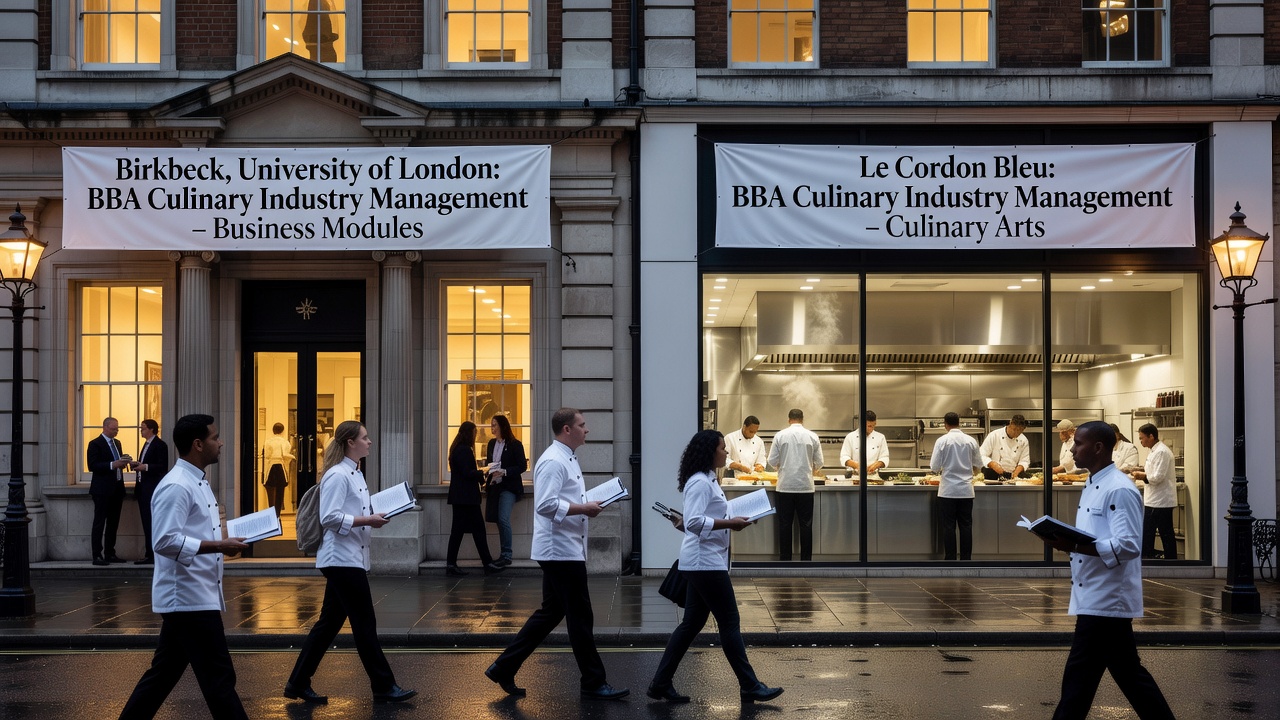
A new undergraduate degree is bringing together two institutions rarely found on the same syllabus: an established London university and one of the world's best-known culinary training names. The BBA Culinary Industry Management, delivered jointly by Birkbeck, University of London, and Le Cordon Bleu Culinary Arts Institute, is described as the only programme of its kind in the UK. It sits at the intersection of hospitality education and business training, reflecting a wider shift in how the food industry expects its future managers and chefs to be prepared.
Why a joint degree matters for the food industry
Kitchens and food businesses no longer run on technical skill alone. Rising operating costs, tighter margins and more complex supply chains mean chefs are increasingly expected to understand budgeting, staff management and business strategy alongside knife skills and menu development. This degree is structured around that reality, combining culinary arts and hospitality study with core modules from Birkbeck Business School. Students split their week between the two institutions, typically attending two classes at Le Cordon Bleu and two evening sessions at Birkbeck, with practical culinary modules taught through demonstrations, workshops and hands-on kitchen sessions rather than lectures alone.
A course built around working life
The structure of the programme reflects an effort to make serious vocational education accessible to people who cannot step away from other commitments entirely. Most teaching happens in the evenings, with Le Cordon Bleu sessions running from 6.30pm to 9.30pm, extending to 3pm-9.30pm for culinary classes in the first year. Some Birkbeck modules offer afternoon options. This timetable model, common across Birkbeck's wider offering, is designed for students balancing study with work, caring responsibilities or other obligations, rather than following a conventional nine-to-five university routine.
The course also includes a summer internship between the first and second years, giving students direct exposure to food service operations, alongside visits and guest talks from industry professionals. Assessment combines traditional academic work, including essays, presentations and case studies, with practical examinations in the culinary modules and a final research project, mirroring the dual academic-vocational nature of the qualification.
Entry routes and who the course is designed for
Birkbeck has structured entry requirements with some flexibility, a position it frames around assessing academic potential rather than relying solely on traditional qualifications. Three-year full-time study requires UCAS tariff points broadly equivalent to grades CCC-BBC at A-level, while a four-year route including a Foundation Year requires significantly lower tariff points and is aimed at applicants returning to education after a break, those without the required subject background, or those who narrowly missed entry grades. Completion of the Foundation Year leads automatically into the main degree.
- GCSE grade C/4 (or equivalent) in English and mathematics is normally expected, with a skills audit option for those without it.
- International applicants generally need IELTS 6.5 overall, with a minimum of 6.0 in each component.
- Students requiring a Student visa must study full-time and on campus, as part-time and online study options can affect visa conditions.
What the partnership signals more broadly
The collaboration reflects a broader pattern in vocational higher education, where institutions pair academic rigor with industry-specific technical training rather than treating them as separate tracks. For an industry where career progression often depends as much on business acumen as on cooking ability, embedding management theory directly alongside professional culinary practice is a deliberate response to how food businesses actually operate. Access to facilities such as Le Cordon Bleu's London centre, combined with Birkbeck's research strengths in management disciplines, is positioned as giving students exposure to both the commercial and creative sides of the sector before they enter it professionally.