
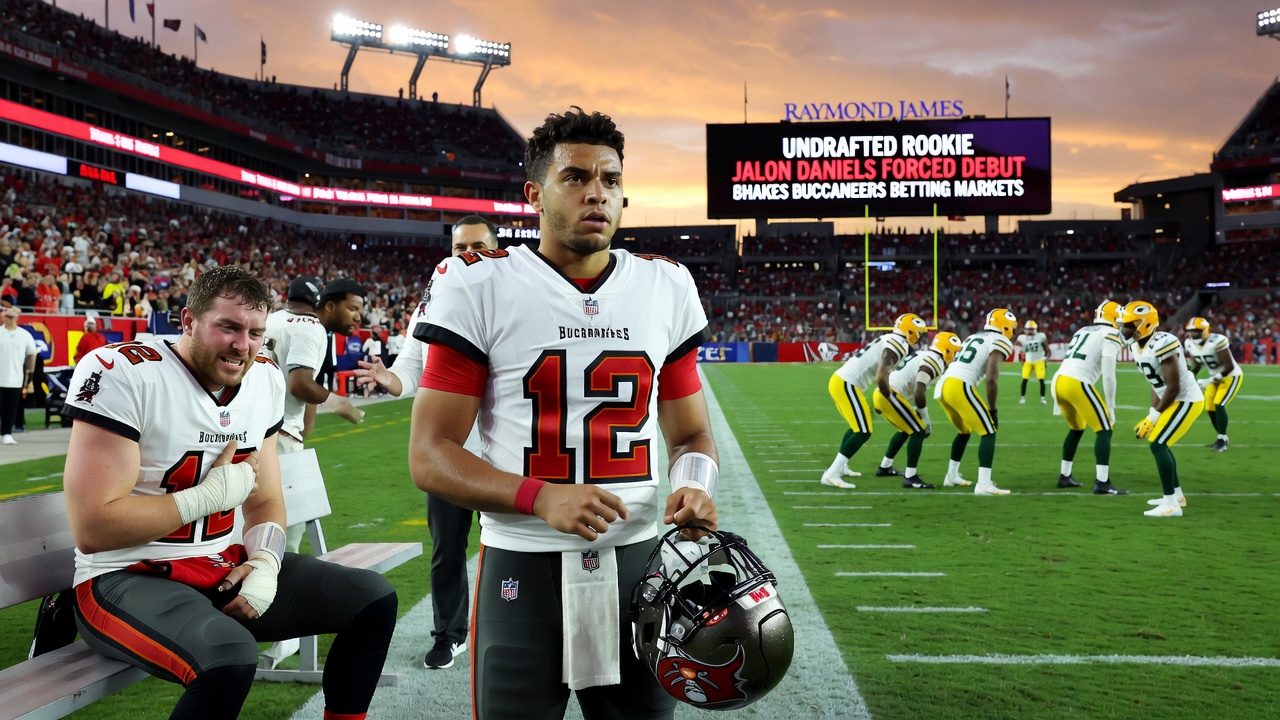
An injury in the final minute of a loss to Minnesota has turned an undrafted free agent into Tampa Bay's starting quarterback with almost no notice. Jalon Daniels, signed out of Kansas without being selected in any draft, entered after Baker Mayfield dislocated his thumb and promptly went 0-for-3 with an interception. He now starts at home against Green Bay, a scenario few fantasy analysts or betting markets had priced in before Sunday.
Why This Matters Beyond One Roster Spot
Quarterback injuries are the single most disruptive variable in NFL betting markets, and an unplanned change at the position moves point spreads, totals, and player-prop markets faster than almost any other news event. When a starter with no professional snaps steps in, oddsmakers face a genuine information gap: there is no NFL sample to model, only college tape and preseason reps. That uncertainty typically widens lines and pushes sportsbooks to shade numbers conservatively until the new starter proves something on the field.
Draft analysts had already flagged the risk profile here. Dane Brugler's evaluation placed Daniels at QB18 in a thin quarterback class, citing an NFL-caliber arm paired with inconsistent decision-making and a worrying turnover history - 19 interceptions and 18 fumbles across his final 24 college games. That kind of profile doesn't disqualify a player from competing, but it does explain why both fantasy rankings and sportsbook pricing treat him with caution rather than optimism.
The Mechanics of Pricing an Unknown Quantity
Sportsbooks and fantasy platforms rely on performance data to set accurate lines and projections. A rookie with three NFL pass attempts, all incomplete, offers almost nothing to work with statistically. This is where market inefficiency can briefly appear: public bettors may overreact to the unfamiliarity of a new name, while sharper money often targets the opposing defense instead. In this case, that logic points toward Green Bay's defensive unit, which enters as a reasonable play for sacks, turnovers, or defensive scoring props against an offense now built around uncertainty at its most important position.
Fantasy football managers face a parallel problem. Skill-position players tied to an unproven passer - in this instance, Tampa Bay's wide receiver corps - get downgraded not because their talent changed, but because the quarterback throwing them the ball is an unknown variable. Rankings reflect probability, not judgment of individual ability.
What Bettors and Fans Should Keep in Mind
- Lines involving first-time starters often carry wider margins to account for limited data.
- Player props tied to a debuting quarterback's supporting cast tend to be depressed until a track record forms.
- Defensive and special-teams props against an unproven offense can reflect real market value without requiring speculation about the new starter himself.
- No wagering approach removes the underlying uncertainty; situations like this are inherently volatile rather than predictable.
Daniels' situation is a reminder that NFL betting markets are reactive systems built on incomplete information during moments of sudden change. The coming weeks will generate the first real data point on whether his college production translates, and until then, both bettors and fantasy managers are pricing risk rather than certainty.