
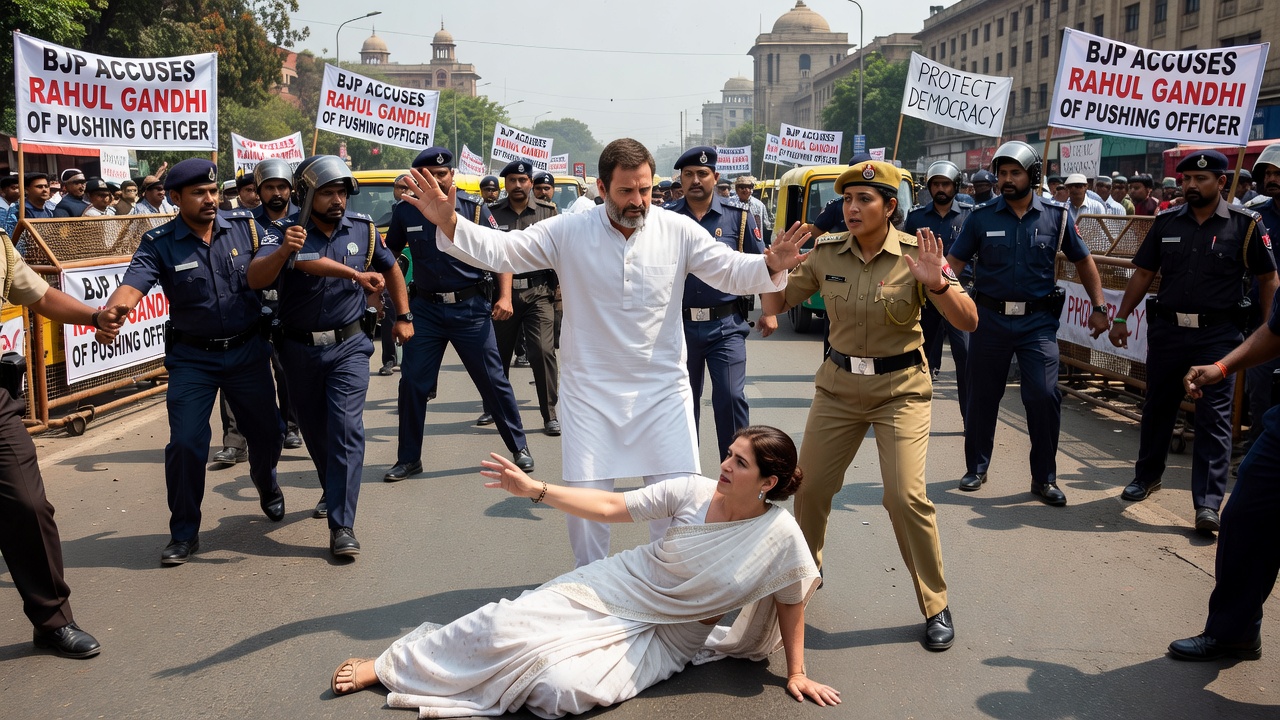
The Bharatiya Janata Party has circulated a video from a recent protest in Delhi that it says shows Leader of Opposition Rahul Gandhi shoving a female police officer. The party claims the footage captures Gandhi standing beside his sister, Congress leader Priyanka Gandhi Vadra, as she lay on the ground while police personnel tried to detain her, and that he pushed an officer attempting to reach her.
What the Video Purportedly Shows
According to the BJP's account, the visuals depict a chaotic moment during the demonstration in which Delhi Police personnel moved to physically remove Priyanka Gandhi from the protest site. The party alleges Rahul Gandhi positioned himself between the officers and his sister, and in doing so pushed one of the women constables attempting to carry out the detention. The BJP has framed this as evidence of inappropriate conduct toward on-duty police staff, a charge that carries both legal and political weight in India, where obstructing or assaulting a public servant on duty can attract criminal provisions depending on the specifics established by investigators.
Political Framing and the Reel Allegation
Beyond the physical altercation, the BJP has added a sharper accusation: that Gandhi's behavior was driven by a desire to stage a moment for social media, suggesting performative politics rather than spontaneous reaction. This framing is a familiar one in contemporary Indian political communication, where parties routinely accuse rivals of manufacturing viral moments for platforms such as Instagram and X. The charge is difficult to verify independently from a single video clip, since intent cannot be established from footage alone, and the party releasing the video has an obvious interest in the narrative it supports.
Why Context and Verification Matter
Protest footage released by political parties is rarely neutral. Clips are often edited for duration, framing, and sequence, and a single camera angle cannot capture the full context of a scuffle involving multiple people, especially one where law enforcement is actively making physical contact with a protester. Independent verification typically requires full, unedited footage from multiple vantage points, statements from Delhi Police, and any formal complaint or FIR that may follow. None of these elements were confirmed in the material released so far, which means the incident remains a contested political claim rather than a settled factual record.
Broader Implications
Incidents of this kind tend to escalate quickly in India's polarized media environment, where opposing parties use selectively shared clips to shape public perception before any formal inquiry concludes. For readers, the responsible approach is to treat such releases as one side's version of events until corroborated by police records, independent footage, or judicial proceedings. The episode also underscores a recurring tension in Indian protest politics: the physical handling of demonstrators, particularly women, by law enforcement frequently becomes a flashpoint that both ruling and opposition parties attempt to weaponize for narrative advantage, often overshadowing the substantive issue the original protest was meant to highlight.