
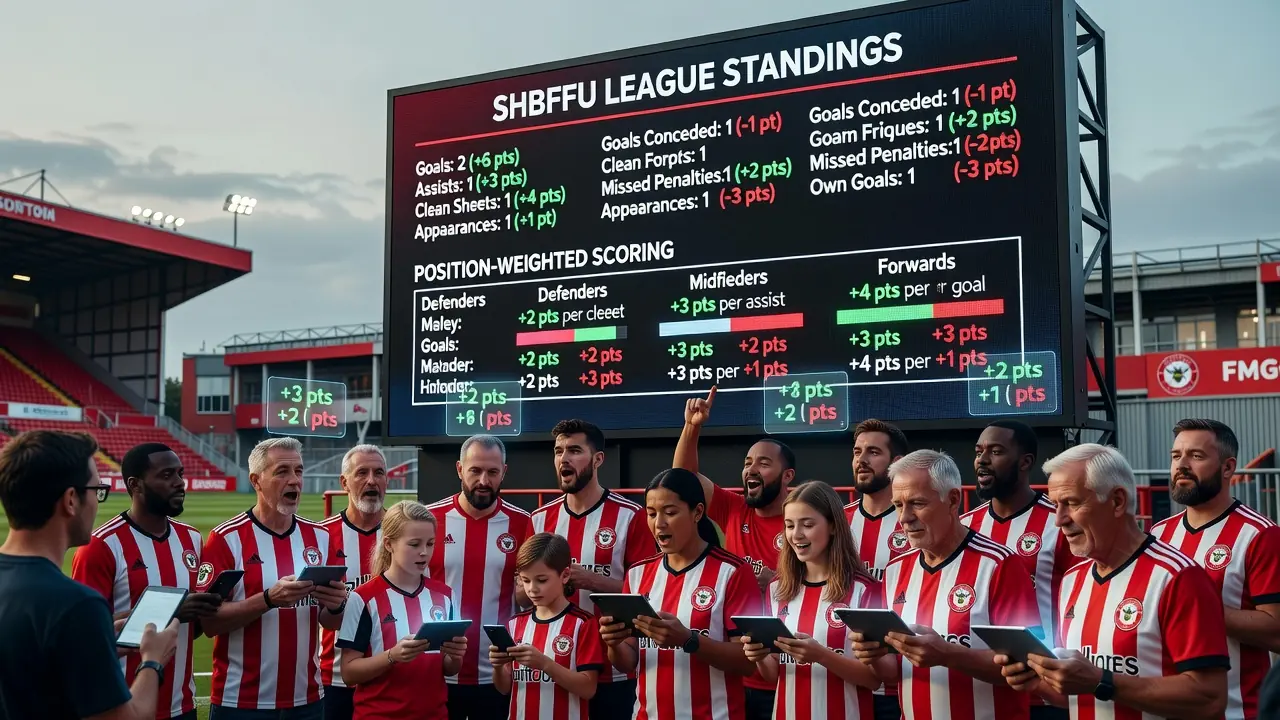
Bees United, the independent supporters' trust affiliated with Brentford FC, has refreshed its fantasy football standings following the club's most recent match. Points across the SHBFFU league have been recalculated using real on-pitch statistics from the game, with updated figures now visible on the team apps and the dedicated fantasy football app.
The update is routine in format but illustrates something broader about how fan-facing digital products in football have evolved. What was once a pen-and-paper pastime for supporter communities is now a data-driven system, mirroring the mechanics of commercial fantasy sports platforms but applied at grassroots, club-trust level.
How the scoring actually works
Each participant's points are tied directly to the real performance of Brentford players in that match. Scoring follows a familiar structure: goals, assists, clean sheets and appearances earn points, while goals conceded, missed penalties and own goals subtract from a player's total. Crucially, the scoring is weighted by playing position, since a defender's clean sheet carries different value to the league table than a forward's appearance. This positional logic is standard across most fantasy football formats, professional or amateur, because it keeps scoring proportionate to the demands and risk profile of each role on the pitch.
Because the system draws on actual match data rather than projections or odds, there is no betting mechanic at play here. It is a statistics-based engagement tool, not a wagering product - a distinction worth making given how often fantasy sports and betting are conflated in public conversation.
Why fan-run fantasy leagues matter
Supporter trusts like Bees United occupy a distinct space in English football's ownership and engagement landscape. Their fantasy competitions are not run for commercial gain but to strengthen community ties among fans, many of whom hold a formal stake or voice in how the club's wider trust operates. The phrase used in the trust's own messaging - "you can't hide from the stats" - captures the appeal: transparency. Every player's contribution is visible, tracked, and converted into a number anyone can check.
This kind of data transparency also reflects a wider shift in how sports organisations and fan groups use applications to deliver real-time engagement. Match-day apps, once limited to scores and news, increasingly host statistical layers that let supporters interact with performance data directly, rather than relying solely on broadcast commentary or post-match summaries.
A low-stakes model worth noting
Unlike commercial fantasy sports or betting products, this format carries no financial stake, odds, or prize structure tied to real-money outcomes. That matters in a regulatory environment where fantasy sports and betting are sometimes scrutinised together. Products built purely around statistical tracking and league-table bragging rights, with no monetary wagering component, sit outside the regulatory perimeter that governs licensed betting operators.
For supporters, the appeal is straightforward: a structured, data-backed way to follow their own club's performances more closely, with the league table updated transparently match by match rather than through opaque calculations.