
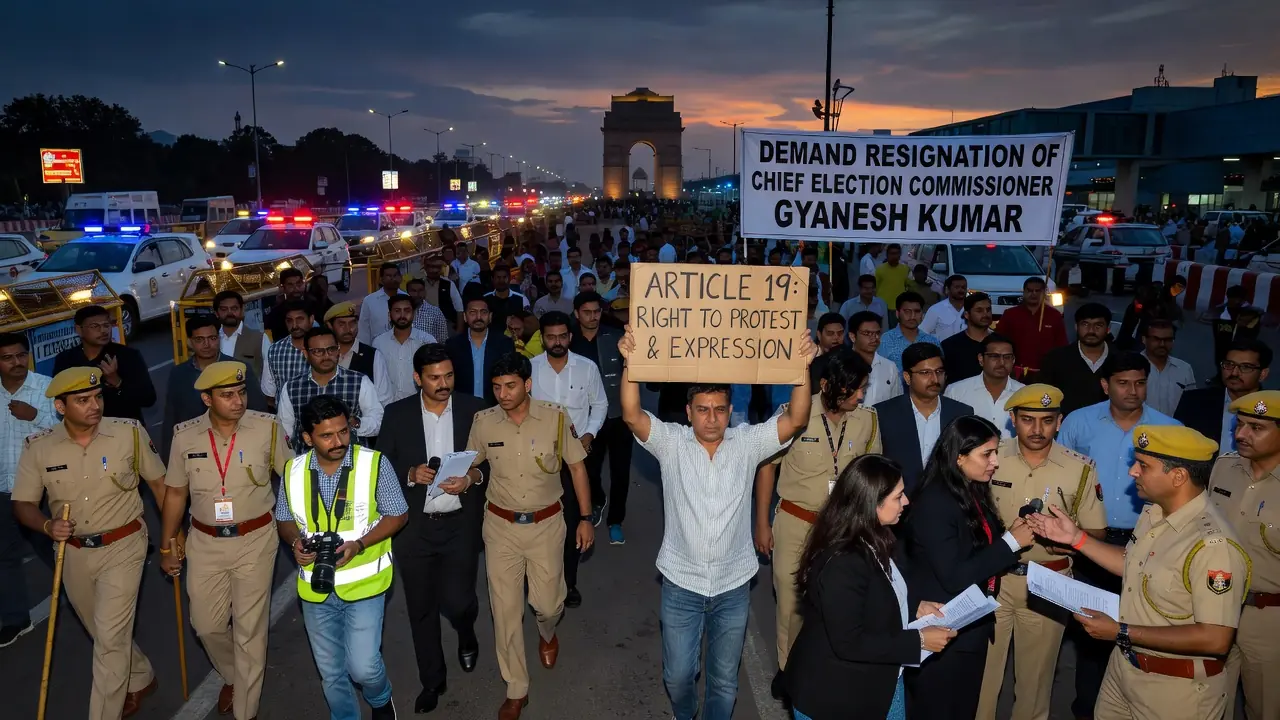
Delhi Police detained dozens of activists and journalists linked to a protest movement challenging Election Commission leadership, with the capital placed under heavy restrictions ahead of a planned demonstration. Among those taken into custody were journalists Abhijeet Dipke and Saurav Das, activist Ashutosh Ranka, YouTuber Dhruv Rathee, influencer Kavya Karnatac and legal coordinator Ratna Singh. Police say roughly 600 people have been detained in total, a figure that includes individuals described as having prior criminal records.
What triggered the operation
The detentions came as organisers prepared for a second major protest demanding the resignation of Chief Election Commissioner Gyanesh Kumar. Several of those detained were picked up directly from an arriving flight, moments after landing in Delhi, a detail that has drawn particular scrutiny because it suggests coordinated monitoring of individual travel rather than a response to an unfolding public disturbance. Dipke had publicly invoked Article 19 of the Constitution before departing, framing the right to protest as a fundamental guarantee rather than a privilege granted by the state.
The legal and political fault line
Indian law permits authorities to impose restrictions on assembly for reasons of public order, and preventive detention provisions exist precisely to allow police to act before an event takes place rather than after. That framework is not new. What makes this case contentious is the scale and the targets: journalists, an organisation's legal head and a prominent content creator with a large online following are not typical subjects of law-and-order action tied to crowd control. Critics argue that detaining people before they reach a protest site, rather than policing the protest itself, blurs the line between maintaining order and suppressing dissent. Supporters of the police action point to the stated number of detainees with alleged criminal histories as justification for a precautionary approach.
Why influencer detentions matter beyond this case
The involvement of a YouTuber with millions of subscribers signals a broader pattern across digital media: individual creators now carry the reach once reserved for broadcasters, and authorities increasingly treat them accordingly, for better or worse. This has implications well beyond politics. In commercial sectors such as advertising, fintech and consumer platforms, regulators have already begun applying traditional media obligations to influencers and online personalities, from disclosure rules to liability for content. The same logic now visibly extends to the political sphere, where a single creator's detention can become national news within hours, amplified by the same platforms that built their audience in the first place.
What comes next
The immediate questions are procedural: on what specific legal grounds were these individuals detained, how long can that detention lawfully continue, and will formal charges follow. The larger question is institutional. India's courts have historically intervened when preventive detention is used broadly against political expression, and this episode is likely to face judicial scrutiny given the profile of those involved and the timing relative to the election commission dispute. How that scrutiny unfolds will matter for journalists, digital creators and ordinary citizens alike, since the precedent set here extends to how freely public criticism of state institutions can be organised and voiced going forward.