
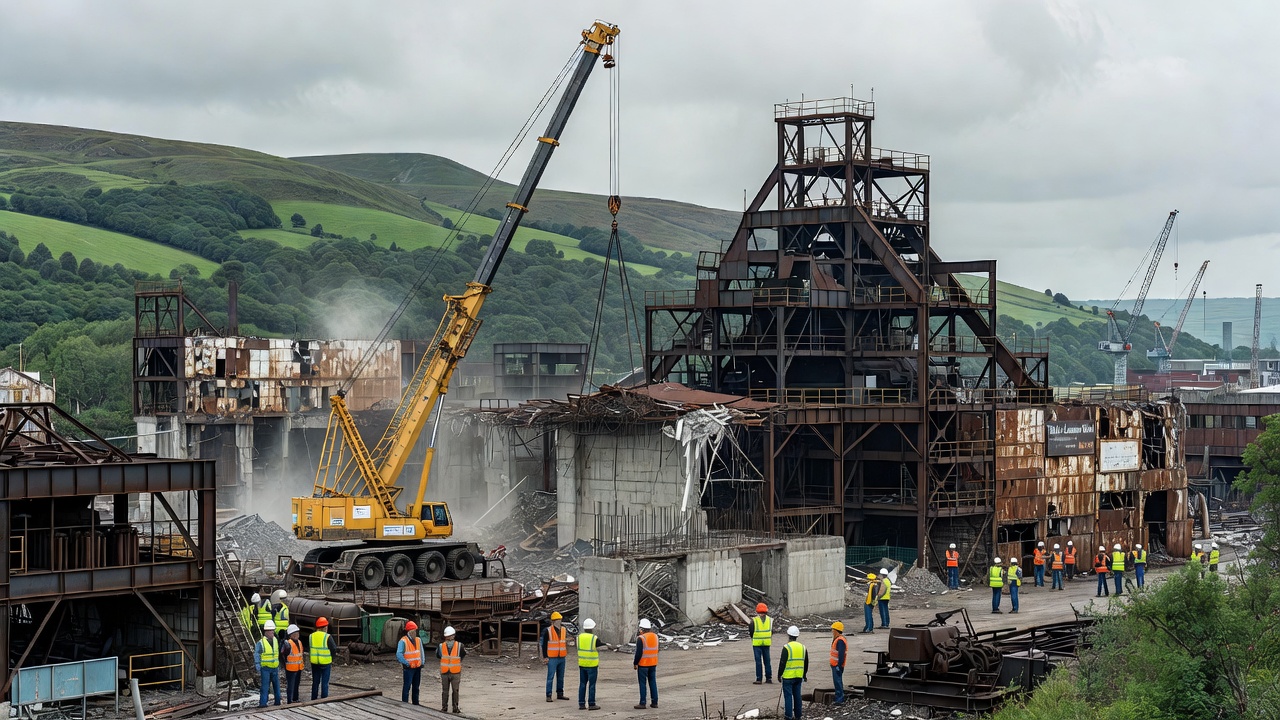
At Llanwern, on the edge of Newport, a crane is dismantling buildings that once anchored one of the world's great industrial complexes. The steelworks, now owned by Tata, is running at half capacity, hundreds of jobs are at risk, and workers describe watching their own workplace disappear piece by piece. The scene is a stark illustration of a wider question now dominating British economic policy: can the country rebuild an industrial base that has been shrinking for half a century?
A sector squeezed from every side
Llanwern's troubles mirror those playing out across Tata's Port Talbot site, where roughly 2,000 jobs have gone as blast furnaces close. The causes are not mysterious. High energy costs have made UK producers less competitive than rivals abroad, while a loosening of tariff protections has allowed cheaper imported steel to undercut domestic output. Stephen Phipson of Make UK argues that reindustrialisation cannot be conjured by government rhetoric alone - it depends on thousands of individual firms choosing to invest, and many are currently holding back.
The pattern extends well beyond steel. UK manufacturing has fallen from around 30 per cent of jobs in the 1970s to just 7.8 per cent today, and now accounts for roughly 8.3 per cent of economic output against 81 per cent from services. Carmakers have been hit particularly hard: Nissan's Sunderland plant, once a model of efficiency, is running at half capacity, with executives citing electricity costs among the highest faced by any Nissan plant globally. Stellantis has shut its Luton Vauxhall factory, and Jaguar Land Rover is cutting thousands of roles amid tariff pressure and overseas competition.
China's shadow over British industry
Much of this strain traces back to China's rise as a manufacturing superpower since joining the World Trade Organisation in 2001. Petrochemicals figure Sir Jim Ratcliffe has accused Chinese producers of oversupplying materials such as PVC and exporting the surplus into Europe at prices domestic manufacturers cannot match - a dynamic he blames for accelerating factory closures in the UK chemicals sector, where output has reportedly fallen sharply since 2021.
Government efforts to court Chinese carmakers such as BYD and SAIC's MG brand reflect the same tension: ministers want investment, but established manufacturers fear being undercut by firms benefiting from state support in their home market. The debate over whether Britain should follow the European Union in considering tariffs on Chinese vehicles remains unresolved, and it sits at the heart of wider arguments about economic security and dependency on a single trading partner.
Echoes of past industrial strategy
Labour's talk of a "new age of industrialisation," championed by Andy Burnham and Chancellor-equivalent figures such as John Healey, inevitably invites comparison with Harold Wilson's 1960s pledge to forge industry in the "white heat" of technology. That earlier project, which created giants like British Leyland and GEC, is now widely regarded as having failed to deliver lasting growth, with most of its flagship companies eventually collapsing or breaking apart. Thatcher's privatisations in the 1980s dismantled much of the state's direct industrial role - making the current push for government to "buy British" and intervene more actively a notable reversal.
Union bodies including the GMB and Unite are pushing for more ambitious action still, calling for nationalisation across energy, transport, steel and other sectors. Supporters argue this could revive industrial communities and create apprenticeship routes outside higher education. Critics point to the cost: British Steel's nationalisation is already reportedly losing substantial sums daily, underlining the financial risk of state ownership without a clear long-term plan for new technology such as electric arc furnaces.
What stands apart - and what doesn't
Not every sector is in retreat. Pharmaceuticals, life sciences, defence and aerospace continue to grow, buoyed by research intensity and strategic demand that are harder to replicate elsewhere. Steel, automotive and chemicals tell a different story - one of ageing infrastructure, high energy costs and global competition that has outpaced policy responses for decades. Whether government investment and rhetoric can shift that trajectory, or whether sites like Llanwern represent an irreversible decline, remains the central question facing British industrial policy.