
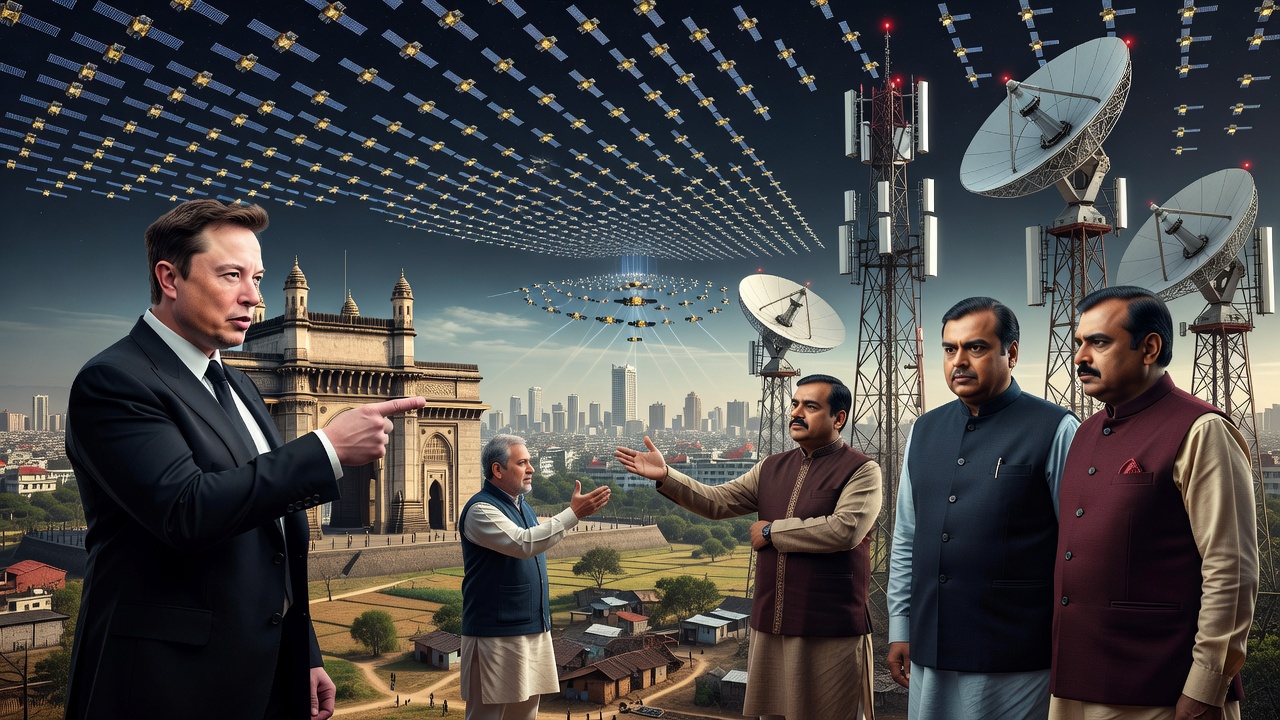
Elon Musk widened a public dispute with India's corporate establishment this week, directly naming billionaire Mukesh Ambani after accusing unnamed "oligarchs" of blocking Starlink's entry into the Indian market. The exchange, which quickly drew in opposition politician Rahul Gandhi, exposes a slow-burning conflict between a foreign satellite internet operator and India's entrenched telecom incumbents.
A Five-Year Wait With No Launch Date
Musk's frustration centers on a timeline that stretches back years. Starlink received an operating license in India in July last year, following preliminary commercial agreements signed in March with Jio Platforms and Bharti Airtel to explore distribution partnerships. Despite clearing that regulatory hurdle, the service has not gone live. Reports have pointed to a freeze on final approvals, reportedly tied to unresolved questions about how Starlink terminals might be used before the service itself is fully licensed for operation. For a company that has deployed satellite internet across more than 170 countries and territories, India represents an unusually prolonged holding pattern.
Why Telecom Incumbents Have a Stake in the Outcome
India's telecom sector is dominated by two players, Jio and Airtel, which together account for roughly 80% of the market. That concentration gives both companies significant influence over how new entrants are treated, particularly in infrastructure-heavy sectors like satellite broadband where spectrum allocation and regulatory sequencing matter enormously. Jio itself is not standing still: Akash Ambani, the company's managing director, told shareholders in June that Jio intends to build its own low-earth-orbit satellite network, reportedly targeting around 1,600 satellites and 23 ground stations. That is a fraction of Starlink's roughly 11,000 satellites currently in orbit, but it signals that Jio sees satellite connectivity as a market it wants to control domestically rather than cede to a foreign operator.
Political Fallout and the Oligarch Framing
Musk's use of the word "oligarchs" landed in an already charged political environment. Rahul Gandhi, India's leader of the opposition, has long argued that major government decisions favor a small circle of powerful businessmen, and he used Musk's comments to draw a comparison to another prominent Indian industrialist, Gautam Adani. Musk's reply - calling the situation "troubling" - suggests he sees value in aligning his grievance with a broader narrative about market access and regulatory favoritism, even as Reliance Industries has declined to comment publicly on the exchange.
What's Actually at Stake for Consumers and Competition
Beyond the personal sparring, this is fundamentally a story about market structure and regulatory discretion. Delayed licensing for a new entrant in a near-duopoly market raises legitimate questions about whether approval processes are being used to protect incumbents' commercial interests rather than to manage genuine technical or security concerns. Satellite broadband could meaningfully extend connectivity into rural and underserved parts of India, where terrestrial infrastructure is thin. How regulators balance security vetting against timely market access will shape not just Starlink's prospects but the broader credibility of India's approach to foreign technology investment. Musk's separate struggles with Tesla in India - reportedly just over 1,000 vehicles sold since launch - add context to a pattern where his companies have found the Indian market harder to crack than anticipated, regardless of where blame ultimately lies.