
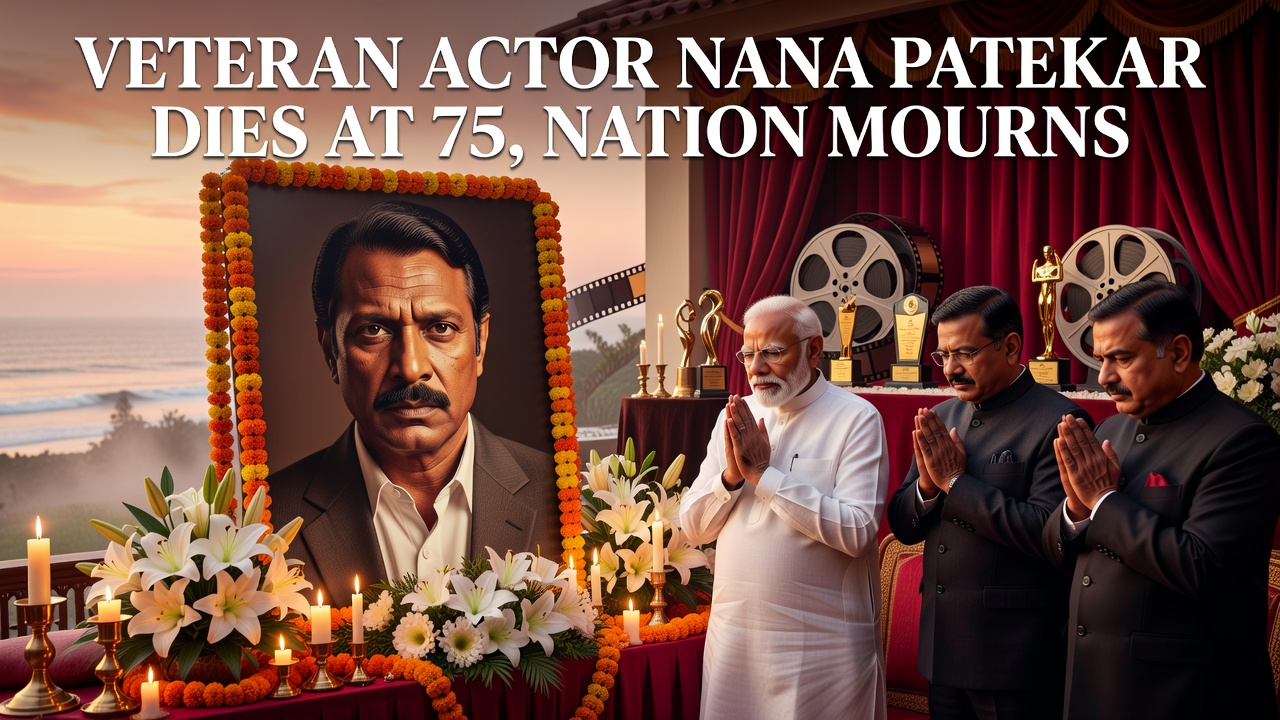
Nana Patekar, one of Indian cinema's most formidable performers, died early Thursday morning in Goa at the age of 75. He was found unconscious at his residence, and the news has sent shockwaves through the film industry and across political circles, with tributes pouring in from the highest levels of government.
A Career Spanning Decades And Languages
Patekar built a reputation over more than four decades as an actor capable of moving seamlessly between Hindi and Marathi cinema, earning acclaim for his intensity and the raw authenticity he brought to every role. He was not a performer who chased box-office formulas; instead, he gravitated toward characters with complexity and moral weight, a choice that earned him both critical respect and a devoted following. His body of work reflects an actor who treated cinema as a craft rather than a vehicle for stardom, and that sensibility shaped how generations of filmmakers and actors viewed his contribution to Indian storytelling.
Tributes From Political Leadership
Prime Minister Narendra Modi was among the first to express grief over his passing, describing him as a powerhouse performer whose work left a lasting imprint on Indian culture. Goa Chief Minister Pramod Sawant and Union Minister Nitin Gadkari also offered condolences, both recalling not only his cinematic achievements but his lesser-publicized work as a philanthropist. Patekar was known for channeling resources and attention toward rural communities, particularly farmers facing economic hardship, a commitment that ran parallel to his acting career and, for many who knew his public record, defined him as much as his films did.
A Legacy Beyond The Screen
What distinguished Patekar from many of his contemporaries was the way he used his public platform. Rather than confining his influence to entertainment, he directed attention and support toward agrarian distress, an issue that has long affected large parts of rural India. This dual identity, celebrated actor and grounded social advocate, is part of why the reaction to his death has extended well beyond the film fraternity into political and civic spaces. His passing marks the end of an era for a generation of Indian cinema that valued depth of performance over spectacle, and tributes from leaders across the political spectrum underscore how far his influence reached beyond the screen.