
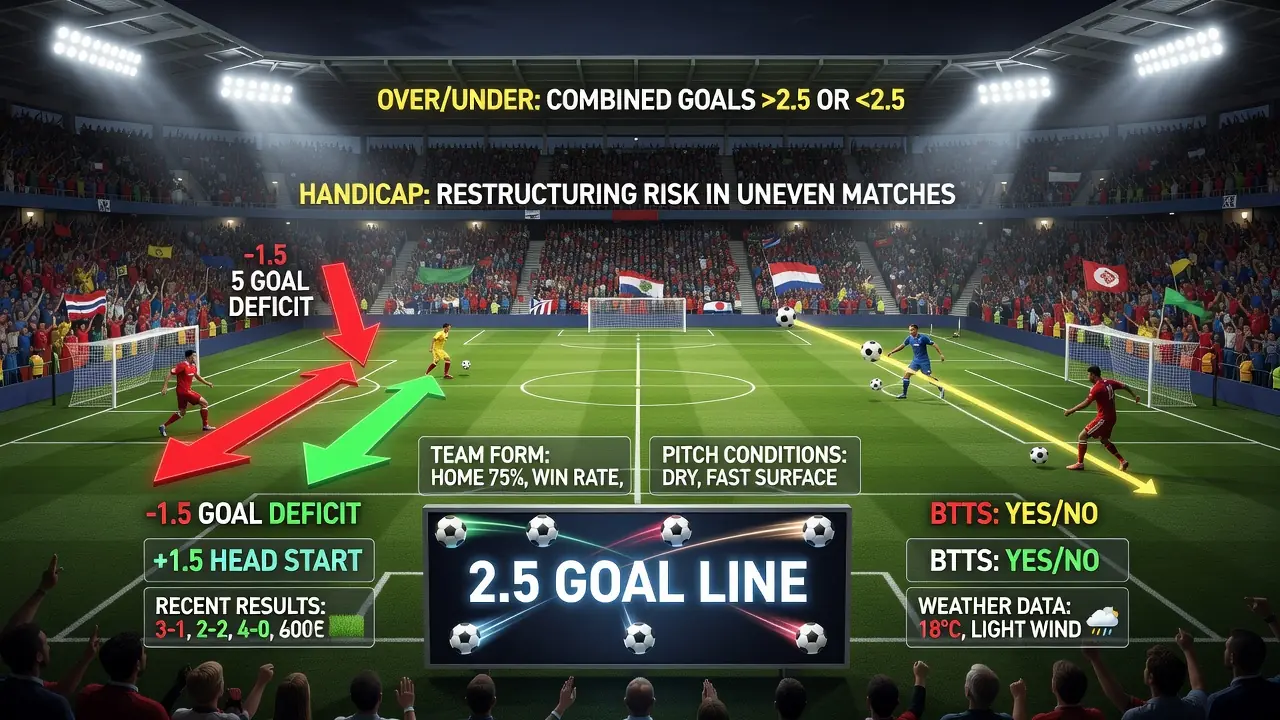
Sports betting has expanded well beyond simple win-draw-win wagers, and three markets now dominate how casual bettors interact with football and other sports: Over/Under, handicap, and Both Teams to Score. Each reflects a different way of pricing uncertainty, and understanding the mechanics behind them matters more than memorizing definitions. The distinctions affect not just potential returns but how exposed a bettor is to variance.
Over/Under: Betting on Totals, Not Winners
Over/Under markets remove the question of who wins and replace it with a question about volume. A bookmaker sets a line - commonly 2.5 goals in football - based on statistical modeling of both teams' scoring tendencies, recent form, and sometimes weather or pitch conditions. A bet on "over" or "under" wins depending purely on the combined final score, regardless of which side the goals come from.
The simplicity is deceptive. Lines are set to balance action on both sides and reflect genuine scoring probability, not sentiment. A low-scoring defensive matchup produces a different line than a game between two attacking sides, and the bookmaker's edge is built into the odds offered on each side of that line, not into the line itself.
Handicap Betting and the Economics of Mismatches
Handicap markets exist because lopsided fixtures produce poor odds on the straightforward outcome. When one team is heavily favored, a standard win bet offers little value - the implied probability is already close to certain. Handicap betting adjusts the contest artificially, applying a goal or point deficit to the stronger side or a head start to the weaker one.
A -1.5 handicap on a favorite means that team must win by two or more goals for the bet to succeed; a +1.5 handicap on the underdog pays out on a win, a draw, or even a narrow loss. This restructuring doesn't change the actual match outcome - it changes the risk profile bettors are exposed to, and it's why handicap markets tend to offer more competitive odds than outright winner bets on uneven matchups.
Both Teams to Score: Isolating One Variable
BTTS strips away the result entirely and focuses on a single binary question: did both sides score at least once? It's popular in leagues associated with open, attacking football, where defensive solidity is less reliable and goals come from both ends of the pitch. The market's appeal lies in its independence from the final result - a 3-1 win and a 1-1 draw settle the bet identically.
That same independence is also its limitation. BTTS says nothing about which team is favored or by how much, so it functions best as a complement to other markets rather than a standalone read on match quality.
Context, Platforms and Responsible Use
Choosing where to place these bets carries its own considerations. Licensed operators are required to display odds transparently, support recognized payment methods, and provide tools for account limits or self-exclusion. These aren't marketing features - they are baseline regulatory expectations in most jurisdictions that license sports betting.
- Odds and lines reflect probability models, not certainty - no market guarantees an outcome.
- Handicap and Over/Under betting can reduce variance compared with outright bets, but they do not reduce the underlying house edge.
- Mobile apps and in-play betting increase speed and frequency of wagering, which raises the importance of setting personal limits in advance.
Understanding how these markets are priced doesn't change the fundamental nature of sports betting as a form of entertainment carrying financial risk. Bettors who treat research and bankroll discipline as core practices are better placed to engage with these markets without losing sight of that risk.